


• Who we serve
    We elevate observability for network service providers whose products are network-powered services.
    • Communication Service Providers
       
      • Telco
        CSPs
        Communication Service Providers:
        Elevated observability for CSPs: turn network data into app experience and behavior insights teams can then use and act inline to optimize traffic and unlock monetization.

        CSP page →


        Value Added Services →
        Turn insights into outcomes. Our Value-Added Services team helps you Do More with network data: operationalize use cases faster, improve efficiency, and accelerate AI-driven innovation.

        VAS page →
      • Telco Solutions
        Who we help
        Mobile and 5G / FWA Operators →
        Transform your network and deliver high-quality application experiences.

        Fixed Broadband (FTTx) →
        Manage larger traffic volumes and deliver innovative services.

        Cable / MSOs →
        Classify and manage encrypted traffic with surgical precision.

        Satellite and Non‑Terrestrial →
        Reduce costs, and optimize service and network performance.

        Use Cases →
      • Value Added Services Thumbnail
         
        Small / Regional CSPs →
        Scalable and affordable network visibility and traffic management.

        CSP Cloud →
        Valuable, real-time data and analytics.

        Interconnect and Hub →
        Seamlessly scale, connect customers, and launch new services.

        Use Cases →
    • Enterprise
       
      • Enterprise
        Enterprise
        Convention and Exhibition Centers
        Exhibitor internet, VIP and sponsor packages as premium products.

        Hospitality and Resorts
        Guest and conference connectivity that matches your brand promise.

        Enterprise page →
      • Campus Thumbnail
        Campuses and Venues
        Campuses and Higher Education
        Prioritize learning, research and collaboration while keeping access fair.

        Multi-Tenant Offices and Retail
        Tenant and shopper connectivity treated as a differentiated amenity.

        Enterprise Use Cases →
      • Enterprise Solutions
        How we help Enterprises
        Observe
        Per-property, per-zone and per-tenant experience visibility.

        Optimize
        Protect ticketing, POS, broadcast and learning apps.

        Personalize and Secure
        VIP, guest and tenant experiences with behavior-aware guardrails.
    • Managed Service Providers
       
      • MSP
        Managed Service Providers
        Venue and Hospitality MSPs
        Premium, tiered connectivity for stadiums, hotels and expo halls.

        Enterprise and SD-WAN MSPs
        App-aware SLAs and managed connectivity for distributed enterprises.

        Aviation, Maritime and Specialized MSPs
        Experience-based services at sea, in air and on remote campuses.

        MSP page →
      • MSP Solutions
        How we help MSPs
        Observe
        Per-customer, per-site and per-app views for your NOC.

        Optimize
        App-aware policies across SD-WAN and carrier links.

        Personalize
        Vertical-specific bundles and white-label portals.
    • GPUaaS and AI Clouds
       
      • GPUaaS and Cloud
        GPUaaS and AI Clouds
        AI Inference Clouds
        QoE-aware policies for stable, efficient inference workloads.

        Training Farms and Data Centers
        Smarter flows for high-intensity training traffic.

        Multi-Tenant Cloud Providers
        Per-tenant experience visibility and control across fabrics and regions.

        GPUaaS and AI Clouds page →
      • GPUaaS and Cloud Solutions
        How we help GPUaaS
        Observe
        Tenant-, job- and region-level QoE and behavior.

        Optimize
        QoE-aware routing and fabric planning to increase GPU utilization.

        Monetize
        Optional premium SLAs and latency tiers aligned to experience.
    Not sure where you fit? We can help you map Elevated Observability to your network services.
    Start with CSP →
  • Suites & Portfolios
    Segment portfolios that bring Elevated Observability to life for CSPs, Enterprises and AI clouds.
    • App QoE CSP Suite
       
      • App QoE CSP Suite
        App QoE CSP Suite
        For Telcos and CSPs
        Elevated Observability for mobile, FWA, fixed, cable and satellite operators.

        Included capabilities
        ActiveLogic, AppLogic, AppLenX, Maestro Policy Engine, IDS, Ops Insights, AI Labs.

        App QoE CSP Suite →
      • Telco Solutions Suite
        What you can do
        Analyze
        Churn, QoE and behavior analytics.

        Optimize
        Traffic, fairness, IPTV/video and CGNAT.

        Monetize
        Experience-based tiers, roaming and sponsored data.
    • Enterprise Suite
       
      • Enterprise Suite
        Enterprise Suite
        For Enterprises and Venues
        Hospitality, venues, campuses and multi-tenant environments.

        For MSPs
        MSP motion that brings ForeSight to your enterprise customers.

        Enterprise Suite →
      • NetEnhance Solutions
        What you can do
        Observe
        Per-site, per-property and per-tenant experience.

        Optimize
        Protect ticketing, POS, broadcast and learning apps.

        Personalize and Secure
        VIP, guest, exhibitor and tenant connectivity offers.
      • Featured Download Image
        Featured Whitepaper
        The Impact of AI on Enterprise Networks
        Most Network Professionals Aren’t ready for AI Traffic. Are you?

        New EMA research explains why observability and optimization must evolve for AI traffic.

        Download Whitepaper →
    • AI Suite
       
      • AI Observability Suite
        AI Suite
        For GPUaaS and AI Clouds
        AI inference clouds, training farms and multi-tenant cloud providers.

        AI and GPU Observability Suite →
      • AI Observability Solutions
        What you can do
        Observe
        Tenant, job, and region-level QoE and behavior.

        Optimize
        QoE-aware routing, CGNAT and fabric planning.

        Monetize
        Premium SLAs and latency tiers aligned to experience.
    All suites run on the same AppLogic Intelligence Stack.
    Start with CSP Suite →
  • Platform & Products
    One AppLogic Intelligence Stack across three layers: Visibility and Enforcement, Context and Enrichment, and Business Enablement.
    • Visibility and Enforcement layer
       
      • Layer 1 Thumbnail
        Products
        ActiveLogic →
        Inline engine for real-time traffic visibility, QoS, shaping and enforcement.

        AppLogic Engine →
        Advanced application classification and QoE scoring.

        AppLenX →
        Flow/xDR-based classification and QoE for off-net domains.
      • Layer 1 Solutions
        What this enables
        Deep Visibility
        See every app, subscriber, device and flow.

        Real-Time Control
        Shape, prioritize and protect critical experiences.
    • Context and Enrichment layer
       
      • Layer 2
        Products
        Maestro Policy Engine →
        Turns business intent and experience rules into network behavior.

        Insights Data Storage →
        Enriched, AI-ready data fabric for analytics and models.
      • Layer 2 Solutions
        Enabling Capabilities
        Traffic Management and Policy Control
        Fairness, heavy-user management and QoE-based prioritization.

        CGNAT for Modern Networks
        Application- and subscriber-aware CGNAT for better troubleshooting.

        Network Churn Intelligence
        Signals for churn propensity, save plays and proactive care.
    • Business Enablement layer
       
      • Layer 3
        Products
        Operations Insights →
        Operational observability for NetOps, Tier III, Care and SRE.

        Enterprise Insights →
        Tenant, site, event and workload experience views.

        AI AppAnalyst →
        Your AI partner for network operations—quick answers, context drilldowns, and automated investigations across apps, users, locations, and time.
      • Layer 3 Solutions
        Who uses this?
        NetOps and Care
        Faster RCA, fewer tickets, better experience.

        Product and Marketing
        Experience-based offers and premium tiers.

        Data and AI Teams
        Reliable features for churn, capacity and monetization models.
    See how the stack powers App QoE, ForeSight and AI and GPU portfolios.
    See Platform overview →
  • Resources
    Learn how leaders elevate observability and do more with network-powered services.
    • Use Cases and Datasheets
       
      • Use Cases Thumbnail
        Use Cases
        Heavy User Management →
        Improve QoE by identifying and managing the network’s heaviest users.

        Carrier Grade NAT →
        Mitigate IPv4 address exhaustion while maintaining network visibility.

        Use Cases →
      • Datasheets
        Datasheets
        Simplified Installation Engine →
        A one-click fully automated system that allows for installation, configuration, and auto-testing in less than 4 hours.

        AppLogic →
        Accurate App identification, categorization, and content classification for enhanced App QoE.

        Datasheets →
    • Case Studies and Whitepapers
       
      • Case Studies
        Case Studies
        Telenet and AppLogic Networks →
        Improving Customer Satisfaction and Reducing Customer Churn.

        OpNet and AppLogic Networks →
        OpNet Reduces Congestion and Improves Customer Satisfaction Using ActiveLogic.

        Case Studies →
      • Whitepapers
        Whitepapers
        Application QoE in the Cloud Era →
        Analytics driven automation can process and suppress non-severe events while elevating only the most critical high impacting events.

        Advanced Traffic Classification →
        Provides a reliable and future-proof foundation for Application and Network Intelligence.

        Whitepapers →
    • Videos and Webinars
       
      • Videos
        Videos
        Importance of App QoE to Inflight Wi-Fi →
        How inflight wi-fi works and how AI-powered traffic management solutions from AppLogic Networks can help.

        Introduction to AppLogic Networks →
        See why AppLogic Networks is the market leader in App QoE.

        Videos →
      • Webinars
        Webinars
        The Future of Network Optimization →
        Optimize network performance and improve customer satisfaction.

        Differentiated Personalized Service →
        Ways small CSPs can enhance their personalization strategies.

        Webinars →
      • CTO Thumbnail
        CTO Corner
        QoE For Critical Apps in Universities →
        How AppLogic measures quality of experience (QoE) for critical apps in real time.

        Building Quality Exhibition Centers →
        How AppLogic Networks helps exhibition centers manage costs, shape traffic, and personalize exhibitor internet packages.

        View all CTO Videos →
    • Industry Trends
       
      • Phenomena Reports
        Phenomena Reports
        GIPR 2025 →
        Understand how users are consuming internet bandwidth across different applications and platforms.

        GIPR 2024 →
        New data, new visualizations and new insights.

        Phenomena Reports →
      • Phenomena Blogs
        Phenomena Blogs
        The 2025 Phenomena Report →
        An annual analysis that provides detailed insights into global internet traffic patterns and the applications driving that traffic.

        Global Internet Usage Continues to Grow →
        Global traffic now over 33 exabytes per day, with users averaging 4.2GB a day.

        Phenomena Blogs →
    • Blogs
       
      • Featured Blogs
        Featured Blogs
        Sandvine’s Commitment on Earth Day and Beyond →
        Every day has to be Earth Day if we are to individually and collectively protect our planet.

        The Yin and Yang of Telecom and Big Tech →
        Network operators want the right to negotiate new business models, but OTT players say everything...

        All Blogs →
      • App QoE Blogs
        App QoE Blogs
        One year as AppLogic Networks →
        To our long-time customers, thank you for sticking with us and shaping our direction. To our new...

        The E & C Journey at AppLogic Networks →
        2025 was a year a significant organizational transformation for AppLogic Networks. Changes were...

        More App QoE Blogs →
      • Blog Subscribe
        Subscribe
        Subscribe to our blog
        Get the latest on App QoE and Elevated Observability.

        Subscribe →
    • Press Releases
       
      • Press Releases
        Latest Press Releases
        AppLogic Networks Completes Live Trial... →
        AppLogic Networks Completes Live Trial at JANOG57 in Osaka, Powering New...

        AppLogic Networks: Putting Business... →
        Nearly one year ago, AppLogic Networks emerged as a new entity, distinct from...

        More Press Releases →
      • App QoE Press Releases
        App QoE Press Releases
        AppLogic Networks Unveils 2025 Global Internet Phenomena... →
        Live sporting events drive new traffic peaks, while new encryption technologies complicate network...

        Sandvine Introduces New AppLogic Product to Help Service... →
        Advanced methods power highly accurate application identification, classification, and...

        More App QoE Press Releases →
      • Blog Subscribe
        Subscribe
        Subscribe to our Press Releases
        Get the latest AppLogic Networks news.

        Subscribe →
    Start with a customer story or dive straight into our technical documentation.
    See all Resources →
  • Company
    AppLogic Networks — elevating observability for network service providers worldwide.
    • About and Vision
       
      • About Thumbnail
        About AppLogic Networks
        Our Story →
        From deep traffic intelligence to Elevated Observability and business outcomes.

        Vision and Values →
        Exceptional Internet experiences, privacy-conscious and human-centered by design.
      • Elevated Observability Thumbnail
        Elevated Observability
        Elevated Observability →
        Connecting experience, context, and action.

        Observability-101 →
        Understand what’s happening inside a network.

        What’s Missing Today →
        Observability should turn telemetry into answers, fast.

        3‑layer stack →
        How we create an Elevated Observability experience.

      • Corporate Responsibility Thumbnail
        Corporate Responsibility
        Our commitment to responsible environmental, social, and governance policies and practices.

        Our Responsibility →
    • Leadership Team
       
      • Executives Thumbnail
        Leadership
        Executive Team →
        Leaders from networks, analytics and software-defined infrastructure.
      • Directors Thumbnail
        Board of Directors
        Learn More →
    • Careers
       
      • Careers Thumbnail
        Careers
        Life at AppLogic Networks →
        Help AppLogic Networks build a smarter internet.
      • Positions Thumbnail
        Positions
        Open Roles →
        Help the world’s networks and service providers do more.
    • Partners and News
       
      • Partners Thumbnail
        Partners and Ecosystem
        Technology and Cloud Partners →
        Integrations that extend the AppLogic Intelligence Stack.

        Channel and GTM Partners →
        Regional and global partners who bring AppLogic to market.

        Partner Portal →
      • News Thumbnail
        News and Press
        Newsroom →
        Announcements, coverage and media resources.

        Blog Articles →
        Learn more about Elevated Observability and Application Quality of Experience.
    • Events
       
      • Events Thumbnail
        Upcoming Events
        Mobile World Congress →
        March 2-5, 2026
        Meeting Rooms: 7F2Ex, 7F6Ex, 7F5Ex

        Satellite Show →
        March 23-25, 2026
        Booth: 1258

        All Events →
      • Sessions Thumbnail
        On-Demand Sessions
        On-Demand Sessions →
        Watch previous briefings and demos.

        All Sessions →
    • Customer Support
       
      • Support Thumbnail
        Support
        Support →
        Get help from the AppLogic Networks support team.

        Customer Portal →
        Get help from the AppLogic Networks support team.

        Customer Downloads →
      • Training Thumbnail
        Training
        Education and Training →
        Instructor-led and online training.

    AppLogic Networks — built on decades of learning how Internet traffic behaves.
    Learn more about AppLogic Networks →
Get a Demo
ALN Blog Banner

Blog | AppLogic Networks

Subscribe Contact PR Team

Options for implementing a ’fair-share’ financial model between telcos and OTTs

Alexander Haväng, Chief Technical Officer
By Alexander Haväng, Chief Technical Officer

July 18, 2023
Back to listing
Recommended
One year as AppLogic Networks
Read More
Recommended
The E & C Journey at AppLogic Networks
Read More
Recommended
AppLogic Networks: Leverages Business Integrity..
Read More
Recommended
What We’re Doing and Why It Matters
Read More
Recommended
When Cloudflare Went Down — From Chaos to Clarity
Read More
Step-one was recognizing the inequity of today’s internet model, step-two, of what to do about it, is much harder. Here are 4 key questions to ask, and some conclusions to draw.

As I wrote last month, EU Parliament recently voted for a resolution to get the largest traffic generators to pay into network upgrades and expansions. The purpose would be to help telcos keep pace with growing traffic demands and to meet the EU’s 2030 Digital Decade targets.

At first glance, this proposal sounds reasonably straightforward and simple. But how service providers would measure, allocate, and bill the largest content providers to recoup some of the billions they invest is not so simple. Would they divide by traffic volumes, content types, subscribers served, revenue gained, or other metrics?

To come up with a practical, transparent, and democratic process, there are many variables to consider: who pays; what is charged; who gets paid; how to measure usage (upstream and downstream); what to charge; OTT-related Opex and Capex; how OTTs would pay.

Below I look at these factors, and then make some rudimentary recommendations for how this could possibly work.

Question 1: Who pays?

We have to start with “Who.” Who will pay, and who will get paid? Neither question is easy since so many parties are involved.

In one model, any party sending a packet to any other party on the internet could pay. Of course, that would not be practical, simple, useful or democratic. So let’s strike that option from the list right away.

In another model, the OTT players making the most money from their content would pay. The problem is that revenues don’t always correlate to traffic volumes or network costs. There are OTTs whose millions of users have almost no impact on network resources, and others whose few users trigger massive network usage.

In considering who pays, it’s also important to consider the different ways in which OTTs generate revenues. Some profit from advertising, others from subscriptions, and yet others from both. And then there’s the issue of non-profits, like Wikipedia – should they pay or not?

These considerations make this option less tenable as well.

So, let’s think about charging by usage – is that an option? It would address the fact that just a few of the world’s largest OTTs use the lion’s share of network resources, driving much of the demand for bigger, faster (and hence, more expensive) networks. But how would you measure usage? It can be measured by tonnage (total volume over time), downstream or upstream or total tonnage, or upstream and/or downstream throughput. The de facto standard, however, is to use 95th percentile of five-minute average throughputs.

It's also important to consider splitting upstream and downstream. Downstream is by far the dominating direction for most networks (not all, of course, as that would be mathematically impossible). Radio networks typically dedicate 90% or so of their frequency domain to the downstream direction. Some access types, like ETTH or FTTH, are typically symmetrical, but other access types have a significantly more expensive and limited upstream. For that reason, you could make a case for counting and charging for upstream and downstream separately.

Splitting by direction makes further sense if you think about the applications themselves. Some apps are upstream-biased, like Dropbox and other cloud-based backup services. Others are symmetrical, like Facetime, Skype, or other communication services. And yet others are heavy on the downstream, like Netflix and other streaming services.

The 95th percentile method has the big advantage of ignoring the worst peaks, as well as ignoring the times when the network is idle. This matters because you have to build capacity for the peak periods, so the OTTs and apps that are most active during the peak period are what will drive your overall cost.

If there were such a thing as an “off-peak app” that generated lots of volume during the non-busy hours of the day, that app would not drive any cost at all, or at least not CAPEX. Every packet and byte transferred on a network carries OPEX costs – e.g., electricity, licenses, labor, etc.

Conclusion for who pays: After considering all the factors I describe above, it seems the top “sources” on the downstream, and the top “destinations” on the upstream should pay for their 95th percentile consumption/production.

Non-profits are not among the top OTT providers for any network that I know, but if they were, I’d assume no telco would feel right taking money from a non-commercial organization.

Question 2: What is charged?

In order to know what to charge, do you first consider the source? If it’s Alphabet, do you separate Google Mail from Google Maps? If it’s Netflix, do you distinguish download from streaming? What about Netflix gaming, or the act of browsing the titles?

If we ask ourselves whether Google, Microsoft, and Apple should be punished for being big, and for being behind the names behind so many services, the answer would be “no,” as that wouldn't feel right.

If Microsoft buys Wikipedia, should Wikipedia traffic be included in the cost model just because it falls under Microsoft? That honestly doesn’t seem to make sense to me.

Conclusion for what to charge: I land in a place that says it’s the “App” that counts. Netflix is clearly an App, as is Google Maps, as is Apple’s AppStore. The “big movers” of throughput during peak periods is what costs the operators the most, and what’s fair is to have traffic generated from and to those apps become a part of the costing.

Question 3: Who gets paid?

The concept of who gets to benefit from a “fair share” model is also non-trivial. There are many types of access networks out there: satellite, cable, DSL, Fiber, mobile, etc., all of which have different usage burdens and cost structures. As you’ll see in the table from the Carmel Group’s 2021 Fixed Wireless and Hybrid ISP Industry Report, there are different cost structures to consider (though these are U.S. based, and used here only for illustrative purposes):
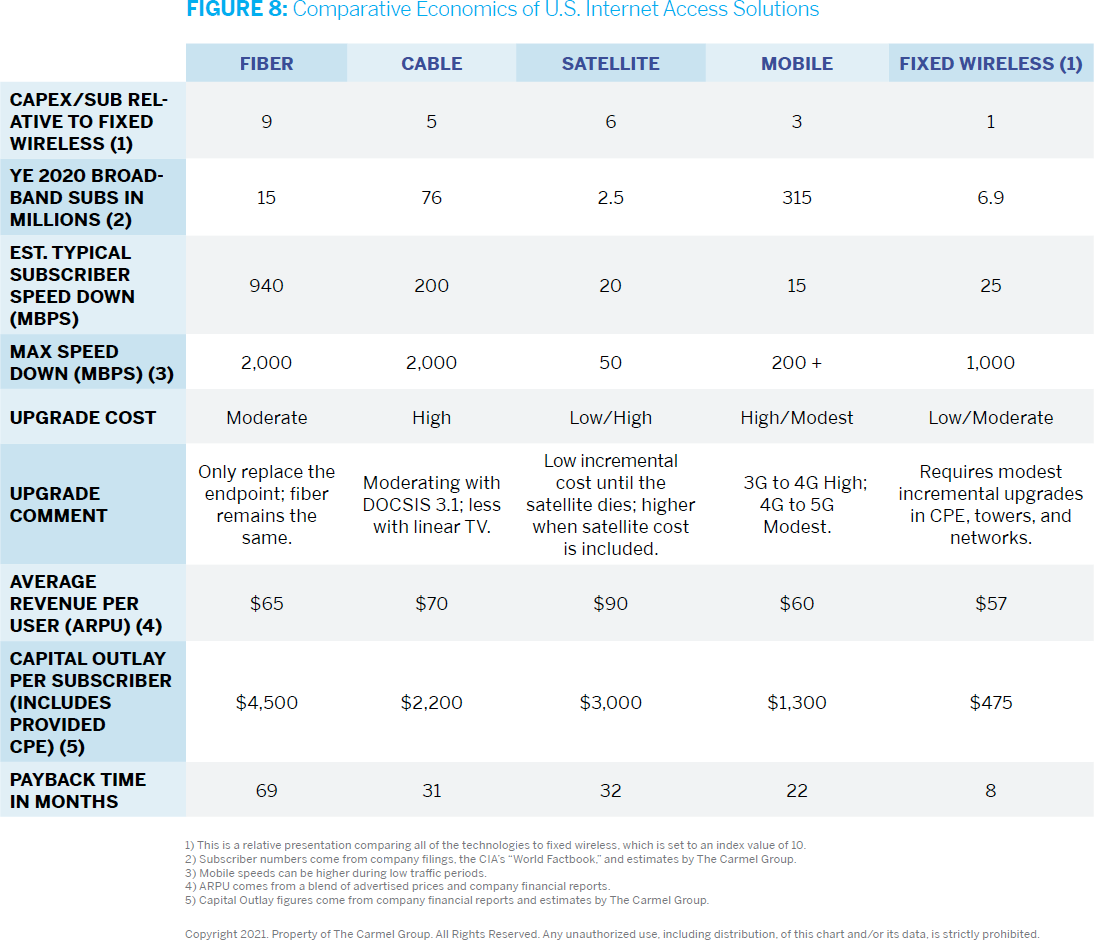
Comparative Economics Image

Some of these networks are built primarily for enterprises, others for consumers or government. Some are for the last mile connecting to the consumer’s home, and yet others for interconnecting continents, or interconnecting telcos.

OTT traffic could conceivably impact all of these networks, and the companies that run the networks could possibly own more than one type.

Considering OTT-related Opex and Capex

The Opex and Capex costs associated with the OTT traffic for each network varies greatly. Some have a large Capex component, like digging a fiber trench for miles to connect a household, or launching a satellite into geostationary orbit. Others have a bigger Opex cost associated, such as electricity for powering a mobile network and pumping radio waves into the ether.

There’s no rational way these costs will ever be fair to the network operator. For those “unlucky” enough to run an expensive network, there will have to be acceptance that they're going to get paid less. If it helps, it can be argued that it’s less expensive and better for the environment to optimize for less power-hungry and resource-intensive networks, like FTTH.

The other dimension is to examine where the majority of CAPEX investment goes. It’s not going to interconnects, sea cables, packet cores, or distribution centers. Rather, the majority of the cost for “running the internet” goes into “last-mile” connectivity to consumers. For mobile networks, that means cell towers and radio networks; for cable networks that means fiber or coaxial cables connecting buildings.

Conclusion for who gets paid: When we home in on the subset of operators that should get the majority of the OTT contributions, it’s those who have subscribers – enterprises or consumers. If you have subscribers, then you have “last-mile” costs.

The scope of this point could be further narrowed to “consumer networks," as enterprise networks have a very different usage profile in that it is not normally dominated by OTT traffic.

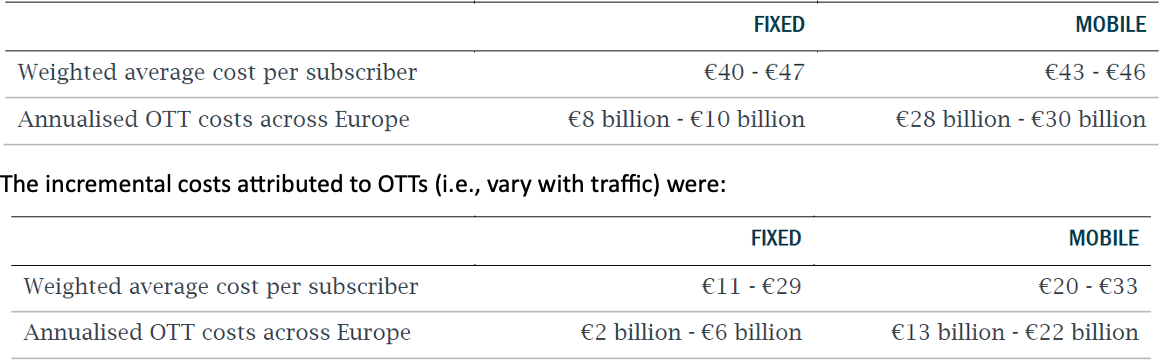
To look further into the OTT costs to EU operators, Deutsche Telekom, Orange, Telefónica, and Vodafone asked Frontier Economics to do a detailed analysis. The result was “Estimating OTT Traffic-Related Costs On European Telecommunications Networks,” and its data suggests the total costs attributed to OTTs in Europe are as follows:
Incremental Costs Image

Because of these incremental costs for supporting OTT traffic, the EU Parliament voted to support the European operators’ argument that OTTs (specifically large traffic generators) should participate in funding network infrastructure, which, as I stated early on, is essential to achieving 2030 Digital Compass connectivity targets.

Question 4: How much should OTTs really pay, and how?

For the sake of discussion, let’s make some assumptions. For example, say Netflix is 13.7% of fixed networks, and 2.4% of mobile networks (source: Sandvine 2023 Global Internet Phenomena Report). Using costs from the table above, that would mean 340 to 530M euros per year in incremental fees for Netflix. Whether the OTT bears all of the cost and through what mechanism is yet to be decided.

Since all networks are different, there’s no way to tell who the top OTT providers are on each network without continual measurement.

Also, there is no way for the OTT to know where it ranks on each network. Each network operator would need to implement a method to count the 95th percentile apps for downstream and upstream, using that information to support the billing process, which will have to be defined by regulators.

It is possible that aggregate app provider-based Usage Detail Records can be generated, with the app owner validating the send/receive information through its own records.

With so much to think about and consider, it’s critical that regulators consult with industry experts. This will better the chances they choose the right mechanisms. It will also better the chances they build a process that is simple, fair, transparent, democratic, and useful. Action on this must be taken soon, to ensure the sustainability of the networks that are increasingly central to all facets of life in Europe and globally.

If you're a service provider currently thinking about these questions and possible solutions, feel free to reach out to me on LinkedIn or schedule an appointment with me at Digital Transformation World in September.


SIGN UP TO OUR BLOG

Topics: OTT, Network Traffic, App QoE, App Quality of Experience, Fair Usage

About the Author

Alexander is the CTO of AppLogic Networks. He likes to think of himself as a creative, and he inspires creativity and innovation among his colleagues. Alexander's specialties are DPI, C, Software, Cowboy coding, productification, AQM and Networking.

LinkedIn Icon

ALN CMYK White Logo Strapline
About Careers Contact
Privacy Policy Legal Information Support
 Subscribe
 Accessibility
 
LinkedIn Icon
YouTube Icon
Facebook Icon
Instagram Icon
BlueSky Footer Icon
LinkedIn Icon
YouTube Icon
Facebook Icon
Instagram Icon
BlueSky Footer Icon